Infinity is only a figure of speech, meaning a limit to which certain ratios may approach as closely as desired, when others are permitted to increase indefinitely.
Introduction
The understanding of infinity that we present here is a dynamic one, and to distinguish it from the common notion we often use the term indefinite, for instance, "indefinitely extensible" or "indefinitely large". In his book "Understanding the Infinite", in the Section "The Finite Mathematics of Indefinitely Large Size", Shaughan Lavine introduces the concept of an indefinitely large size, which is nevertheless finite. His ideas are based on a work of Jan Mycielski about locally finite theories. The central idea of Mycielski is that the range of the bound variables inside a single formula may increase. For instance, in a formula the variable refers to objects in some (finite) carrier set and a further quantification, e.g. by , refers to a (finite) set , being indefinitely large relative to .
A main disadvantage of Mycielski's approach is the fact that the indefinitely large sets are given by predicates , used as restrictions of bounded variables, which are part of the language. Their exchangeability and further properties must be formulated as additional axioms, having nothing to do with the content of the theory. Furthermore, all formulas have to be translated in order to interpret them in a finitistic way. Lavine's approach then uses these finitistic structures in contrast to models with infinite totalies. In particular, the set theoretic axioms have two versions, the original infinite ones and the translated finitistic ones.
A more natural way to deal with these restrictions of bounded variables is to consider states of extensible sets instead of , i.e., the predicate is replaced by a state of an increasing set , with being an indefinitely large index relative to the context from which the free variables are chosen. In this model-theoretic approach there are not two worlds, the finitistic one and a world with infinite sets, but being infinite is being an indefinitely extensible finite. This approach also allows natural extensions to other logics, e.g. higher-order logic, and the investigation of new meta-mathematical properties.
The Potential Infinite
The distinction between potential and actual infinity goes back to Aristotle, who rejected the latter. An actual infinite set is a fixed, completed set and to call it infinite is saying that its size is larger than every finite size. We might thus say that infinity is seen as a size in this case. The potential infinite is based on a dynamic perspective towards an infinite set, which cannot be completed by definition. Every completion is only temporary and just results in another stage of this endless process. The possibility to always extend an infinite totality of objects is more fundamental than (and in contrast to) having a completed totality.
The Potential Infinite and Finitism
The locution "potential infinite" is a technical term, there is no infinity involved in this concept. The potential infinite is a form of finitism, since at each stage there are only finitely many objects. If we refer to a potential infinite set, we necessarily have to refer to some state with finitely many elements. Often finitism is regarded as a view that postulates a fixed bound. The form of finitism resulting from a potential infinite in contrast has a variable bound that depends on factors which can be specified precisely, if needed. So the distinction finite vs. infinite becomes a fixed vs. variable difference in this case. This requires a reinterpretation, or better, a finitistic reading, of the universal quantifier.
Paradoxes of the Actual Infinite
Actual infinities have several counter-intuitive properties. This starts with simple examples, e.g. there are as many natural numbers as even numbers. More complex examples are the Banach-Tarski paradoxon, as a consequence of the idea that a continuum is an actual infinite set of points. Paradoxes such as those of Zeno (e.g. Achilles and the tortoise), Hilbert's hotel, Thomson's lamp or the Ross-Littlewood urn may arguably not fall into the mathematical realm, but they show that actual infinities in mathematics are not applicable to real world situations.
The deficiency of this view is not the fact that actual infinite sets have unfamiliar properties, but the fact that these "properties" stem from relations and dependencies between infinite sets which have been removed. Simply taking these dependencies into account prevents these paradoxes, which arise as self-made problems that have nothing to do with the mathematical content.
And even more, to introduce actual infinities does not eliminate the phenomenon of indefinite extensibility. After establishing infinite sizes in form of ordinal and cardinal numbers, the question arises naturally, what is the size of the totality of these infinite numbers. It is well known that this again leads to contradictions or paradoxes and a satisfying solution is not available. Some attempts are done with reflection principles or with hierarchies of Grothendieck universes. Often a notion of small versus large is introduced, being basically a variant of the original distinction of finite versus infinite.
Removing a Dependency
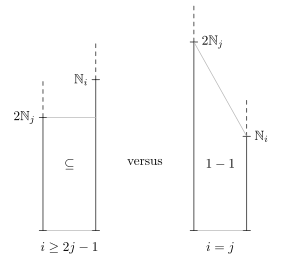
Since each (potential) infinite set has its own way of exhausting its elements, these processes can be related to each other. If we switch to an absolute completion of this process, not only a temporary stage, this removes the dynamic and dependency. This is best seen at one of the simplest paradoxes: An infinite set has the same size as a proper subset, whereby "same size" should mean a one-to-one correspondence of elements. For instance, the set of natural numbers has the same size as the set of even numbers, given by the bijection .
If we regard both sets as processes, there are different ways to relate them. The set cannot be given as a whole, but solely by some state and similarly , say by the state . The set is a subset of only if and there is a one-to-one correspondence only if , see Figure 1. Both requirements are not meet at the same time if . But if we imagine that and arrive at the infinite, given by a state , the simultaneous satisfaction of both requirements becomes possible (since and are equal as cardinal numbers). So the paradox is removed if we do not allow this step to a completed infinite state, which moreover contains an incontinuity: for becomes in the limit.
Indefinitely Large
To call a set (potential) infinite has two aspects in our approach. First it refers to indefinitely extensibility. Secondly, it may refer to an indefinitely large state . By that, a completed infinite set can be regarded as an indefinitely large finite set for which the state plays no role and is therefore not mentioned. The important point is that if a set is indefinitely large, then it is large enough to have all properties that an actual infinite set has (except of being completed).
The Indefinitely Extensible
The basic property of the potential infinite is that of being indefinitely extensible, including Dummett's understanding. He defines: An indefinitely extensible concept is one such that, if we can form a definite conception of a totality all of whose members fall under that concept, we can, by reference to that totality, characterize a larger totality of all whose members fall under it. The ordinal numbers and sets are a typical example: If we refer to "all sets", this creates or reveals a new set and thus the totality of all sets has changed.
But already the natural numbers form such an indefinitely extensible concept. If we refer to the number of all numbers, then this reference creates a new number. First there is no number, hence the number of numbers is 0. So we created a first number, namely 0, and the number of numbers is 1. Henceforth there are the two numbers 0 and 1, creating number 2 and so on.
The Indefinitely Large Finite
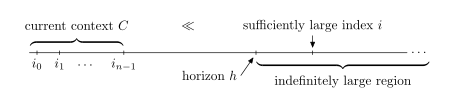
Based on the idea of indefinite extensible totalities the main concept is a notion of an indefinitely large finite, which could be seen as a relative infinite. If denotes the set of states or indices, then a relative infinite is a relation (or ) between an index and a context , with , stating that is indefinitely large or, using a more technical notion, sufficiently large relative to .
We can only investigate finitely many objects in a way that we explicitly refer to them. Say these are currently . Most often these objects are not fixed but variable ones, taken from some infinite sets. Assume that are (variable) natural numbers, then saying that is a natural number means for some stage . So the currently investigated objects, here , are always within a context .
The notion of an indefinitely large finite is relative in three ways. First, it is not a single state , but a region, e.g. , the indefinitely large region. If there is a least element in this region, we call it horizon. Secondly, the region depends on a context , it is thus a relation . Figure 2 illustrates this situation. And thirdly, it is not a single relation but several ones. Their basic properties are that implies and additionally that holds for all . The latter expresses a dependency of the size of set from the sizes of the sets . If it is necessary to include the indefinitely large set into the current context as a further set , then the current context becomes . We may then again choose an indefinitely large index .
By seeing infinity as an indefinitely large finite, the infinite is not outside of an indefinitely extensible set, it is a part of it. It is only outside the region that we can reach from the current stage with our current means. The indefinitely large finite sets with behaves exactly as actual infinite sets in the current context of investigation. But they are not completed in an absolute way, i.e., if we change the context, an extension could be necessary.